Skip to content Skip to footer
Treatments

Prosthodontics

Prosthodontics is the branch of dentistry focused on replacing and restoring teeth with custom-made dental prosthetics — crowns, bridges, dentures, and implant-supported restorations. It covers everything from a single crown on one tooth to a full-arch replacement of an entire set of teeth, plus related care such as night guards and jaw-joint (TMJ) assessment.

What This Page Covers

Some of the most common prosthodontic procedures are common enough to have their own detailed pages: zirconia crowns, E-max crowns, dental bridges, and dentures. Laminate veneers, which sit at the cosmetic end of prosthodontic work, have their own page too — see laminate veneers. This hub covers the remaining prosthodontic procedures that don’t yet have their own page.

Prosthodontic work is broadly divided into fixed restorations, which the patient cannot remove, and removable restorations, which come in and out. Both approaches appear in the sections below, and the right one for a given case depends on how many teeth are missing, the condition of the remaining teeth, and whether implants are involved.

Porcelain-Fused-to-Metal (PFM) Crowns

A PFM crown has a metal substructure covered by porcelain. It was the standard crown material before all-ceramic options like zirconia and E-max became widely available, and is still used in some cases, for example where cost or a very high bite force is a factor. Its main drawback is that the metal edge can eventually show as a thin dark line at the gumline as gums recede, and it can trigger sensitivity in patients with a metal allergy. See zirconia crowns and E-max crowns for the metal-free alternatives.

Precision Attachment Dentures

A type of partial denture that clips onto crowns on the remaining natural teeth using a hidden mechanical attachment, rather than visible metal clasps. It gives a more discreet appearance than a standard clasp-retained partial, but generally involves crowning the supporting teeth and a more complex laboratory process, which typically makes it a higher-cost option than a clasp-retained partial. See the dentures page for the wider range of denture types.

Temporary Crowns and Bridges

A provisional restoration placed while a permanent crown or bridge is being fabricated in the laboratory. It protects the prepared tooth and maintains appearance and chewing function in the meantime, usually made from acrylic or composite resin, and is typically replaced with the final restoration within one to two weeks. A temporary is not meant to withstand the same forces as the final piece, so patients are generally advised to chew carefully on that side in the interim.

Implant-Supported Crowns

A single crown attached to a dental implant instead of a natural tooth root, used to replace one missing tooth without altering the neighboring teeth. This requires the implant to be placed and given time to heal before the crown is attached.

Implant-Supported Bridges

The same concept as an implant-supported crown, scaled to replace multiple missing teeth at once, anchored on two or more implants instead of natural teeth. See dental bridges for how a bridge is designed and fitted.

Implant-Supported Overdentures

A removable denture that clips onto a small number of implants for far more stability than a conventional denture, while remaining removable for cleaning. See dentures for the full range of denture options.

Implant-Supported Fixed and Removable Prostheses

A broader category covering both fixed, full-arch replacements permanently attached to implants and removable full-arch options anchored the same way. The right approach depends on available bone volume, the number of implants placed, and patient preference.

TMJ Examination

An assessment of the temporomandibular joint (TMJ, the jaw joint) and the surrounding muscles, usually prompted by symptoms such as jaw clicking, discomfort while chewing, or difficulty opening the mouth fully. The exam helps determine whether further evaluation, a night guard, or a referral is the appropriate next step.

Night Guards

A custom-made appliance worn over the teeth, usually at night, to reduce the direct contact and wear caused by clenching or grinding (bruxism). A night guard helps protect natural teeth and existing dental work, such as crowns, from excess wear — it does not stop the grinding habit itself.

Occlusal Splint Therapy

A broader term for custom oral appliances used to manage how the upper and lower teeth meet. Occlusal splints can be used to help manage jaw-joint symptoms, to protect teeth from the effects of grinding, or as part of planning before extensive restorative work, and are typically adjusted over time as the bite or symptoms change. The design — a hard acrylic splint, a softer nightguard-style appliance, or another form — depends on what the assessment finds and what it’s intended to address.

Several of the procedures above depend on a dental implant already being in place and healed. For how implants are placed and the healing timeline involved, see the dental implants page.

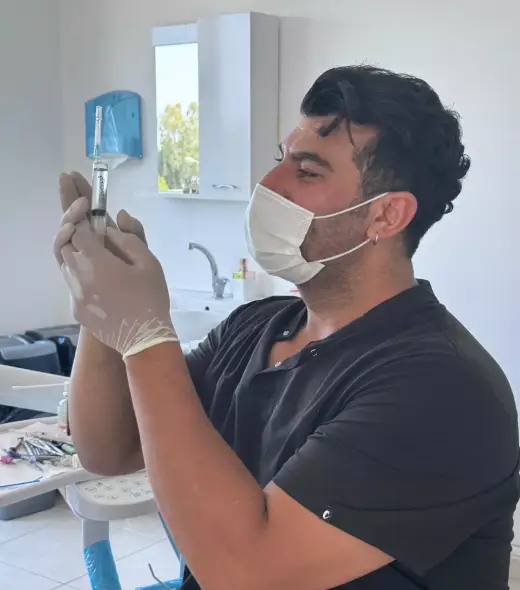
Dt. Cebrail Sağlam, dentist in Alanya
Dt. Cebrail Sağlam preparing an anaesthetic during treatment
FAQ

Frequently asked questions

Prosthodontics covers custom-made replacements for missing or damaged teeth — crowns, bridges, dentures, and implant-supported restorations — along with related care such as night guards and jaw-joint (TMJ) assessment. See the sections above for how each procedure works.

A fixed prosthesis, such as a crown, bridge, or implant-supported bridge, is permanently attached and cannot be removed by the patient. A removable prosthesis, such as a denture or overdenture, comes in and out for cleaning. Which one fits a case depends on how many teeth are missing and whether implants are involved.

PFM crowns are still used in some cases, though all-ceramic options like zirconia and E-max have become more common because they’re metal-free. See zirconia crowns and E-max crowns for those alternatives.

A night guard is often recommended for patients who clench or grind their teeth, since it helps protect both natural teeth and dental work such as crowns from excess wear. Whether one is needed depends on an individual assessment, not on having crowns alone.

It depends mainly on implant healing time, which is commonly a few months, before the final crown or bridge can be attached. See the dental implants page for that timeline in detail.

Next step

Questions about this treatment?

Every case is different. The most useful first step is an examination, where the options for your teeth can be explained in person.