Skip to content Skip to footer
Restorative Dentistry

Children's Dentistry

Children’s dentistry covers the treatments baby (primary) teeth need — fillings for decay, protective crowns, treatment for a tooth’s nerve when decay goes deep, space maintainers when a tooth is lost early, and extractions when a tooth can’t be saved — alongside preventive steps like fluoride and sealants. Primary teeth matter even though they’re temporary: they hold space for adult teeth, support chewing and speech development, and an infected or abscessed baby tooth can affect the permanent tooth developing underneath it.

What Children's Dental Treatments Cover, and Who They're For

This page covers dental treatment aimed specifically at baby (primary) teeth and the mixed-dentition years, as opposed to routine care that applies at any age — see the dental checkup page for that. It’s relevant for parents whose child has a cavity, a damaged tooth, or a tooth lost earlier than expected, as well as for preventive treatments like fluoride and sealants that are commonly recommended once a child’s molars have erupted.

Dt. Cebrail Sağlam, dentist in Alanya
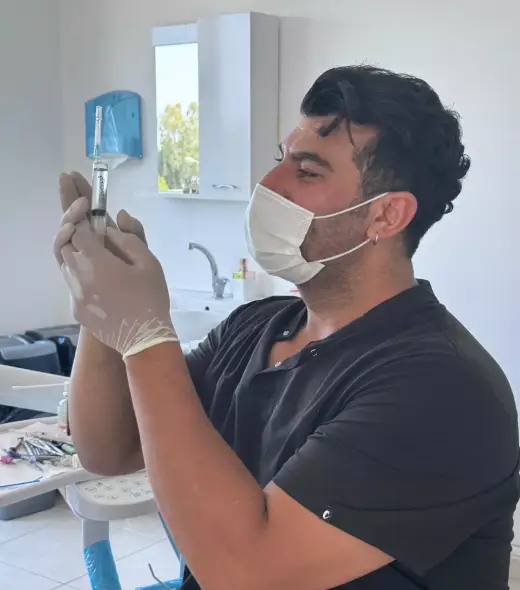
Dt. Cebrail Sağlam preparing an anaesthetic during treatment

Children's Dental Treatments We Cover

Primary Tooth Fillings

When decay affects a baby tooth, a filling removes the decayed material and restores the tooth’s shape and function with a filling material, in much the same way a filling works on an adult tooth. Treating decay in a primary tooth, rather than leaving it, matters because an untreated cavity can progress to infect the tooth’s nerve and can affect the permanent tooth still developing below it.

Pulpectomy

A pulpectomy is used when decay or injury has reached the nerve and blood vessels (the pulp) of a baby tooth and the whole pulp needs to be removed, similar in principle to a root canal on an adult tooth. The canal space is cleaned and filled with a material designed to resorb naturally, in step with the tooth’s own root, since a baby tooth’s roots are meant to dissolve as the permanent tooth beneath it develops.

Pulpotomy

A pulpotomy is a more limited procedure than a pulpectomy: only the inflamed or infected portion of the pulp — typically the part inside the crown of the tooth — is removed, while the healthy pulp in the root is left in place and protected with a medicated dressing. It’s generally considered when the deeper root pulp still appears healthy, allowing the tooth to be kept rather than treated more extensively or extracted.

Stainless Steel Crowns

A stainless steel crown covers a baby tooth that has extensive decay, has had root canal treatment (pulpotomy or pulpectomy), or is at high risk of breaking — situations where a filling alone wouldn’t hold up until the tooth is naturally lost. It’s a pre-formed metal cap fitted over the prepared tooth, chosen for its durability through the years the primary tooth is still in use.

Space Maintainers

When a baby tooth is lost earlier than it naturally would be — through decay, injury, or extraction — a space maintainer is a small fixed or removable appliance that holds the gap open. Without one, neighboring teeth can drift into the space and block the permanent tooth from erupting into its correct position, which is the specific problem a space maintainer is designed to prevent.

Fluoride Application

A fluoride varnish or gel is applied directly to the teeth to help strengthen enamel and make it more resistant to decay. It’s typically done as a quick step during a checkup, not a separate long appointment, and is one of the more common preventive measures recommended for children at higher risk of cavities.

Fissure Sealants

Sealants are a thin protective coating applied into the deep grooves (fissures) of the back molars, where a toothbrush bristle often can’t reach effectively and where most childhood cavities start. The tooth surface is cleaned and dried, and the sealant material is applied and set, without removing any tooth structure — it’s a preventive step, not a restorative one.

Pediatric Tooth Extractions

An extraction is considered when a baby tooth is too damaged by decay or infection to be restored with a filling, pulpotomy, or crown, or when it needs to come out for orthodontic reasons on a dentist’s recommendation. Where a tooth is removed well before it would naturally fall out, a space maintainer is often discussed at the same time to protect the space for the permanent tooth coming in behind it.

How Many Visits, and What Influences the Number

The number of visits depends entirely on what needs treatment: a single filling may need one appointment, while a pulpotomy with a crown, or treatment across several teeth, is usually spread over more than one visit. What a child can comfortably manage in one sitting is also a practical factor the dentist takes into account when planning treatment, separate from the clinical complexity of the procedure itself.

Preparing a Child for a Dental Visit

Explaining a visit in simple, factual terms ahead of time — what will happen, and that the dentist is there to help keep their teeth healthy — tends to help more than surprising a child on the day. Scheduling for a time when a child is usually rested and not overly hungry can also make a visit go more smoothly.

Before you decide

Not sure whether this applies to your teeth?

The only way to know is an examination. Ask a question first if you would rather understand the options before booking anything.

Dental X-Rays for Children

X-rays are sometimes needed to check for decay between teeth or below the gumline, or to see how permanent teeth are developing beneath the baby teeth — information that isn’t visible from a visual exam alone. Digital X-ray systems use a low dose of radiation, and a lead apron or thyroid shield is standard protective practice during the exposure. X-rays for children are taken selectively, when the specific information is needed, not as a routine step at every visit.

Contraindications and When a Referral Makes Sense

Not every case is straightforward. A child who is very young, highly anxious, or needs extensive treatment across many teeth may be better served by a setting with specific pediatric behavioral-management training or sedation options. Medical conditions that affect bleeding, healing, or anaesthesia should always be discussed with the dentist before treatment is planned.

FAQ

Frequently asked questions

General guidance in pediatric dentistry commonly points to around the time the first tooth appears or by a child’s first birthday, whichever comes first, so that any risk factors can be spotted early.

Yes, generally — an untreated cavity can cause pain, spread infection to the tooth’s nerve, and in some cases affect the permanent tooth developing underneath. Baby teeth also hold space for adult teeth and support normal chewing and speech until they’re naturally lost.

A pulpotomy removes only the affected portion of the tooth’s nerve tissue, usually in the crown, and leaves healthy root pulp in place. A pulpectomy removes the entire pulp, root portion included, and is used when the infection or damage has reached further into the tooth.

A crown is generally considered when decay is too extensive for a filling to hold up reliably, after root canal treatment on a baby tooth, or when a tooth is at high risk of breaking — situations where the crown’s durability matters more than it would for a smaller cavity.

It’s a small appliance that holds open the gap left by a baby tooth lost earlier than expected, so neighboring teeth don’t drift into the space and block the permanent tooth from coming in correctly. Whether one is needed depends on which tooth was lost and how much time remains before the permanent tooth is due to erupt.

Digital X-rays use a low radiation dose, and protective measures such as a lead apron are standard practice. As with any imaging, X-rays for children are taken selectively — only when the dentist needs specific information that a visual exam can’t provide — rather than routinely at every visit.

Next step

Questions about this treatment?

Every case is different. The most useful first step is an examination, where the options for your teeth can be explained in person.