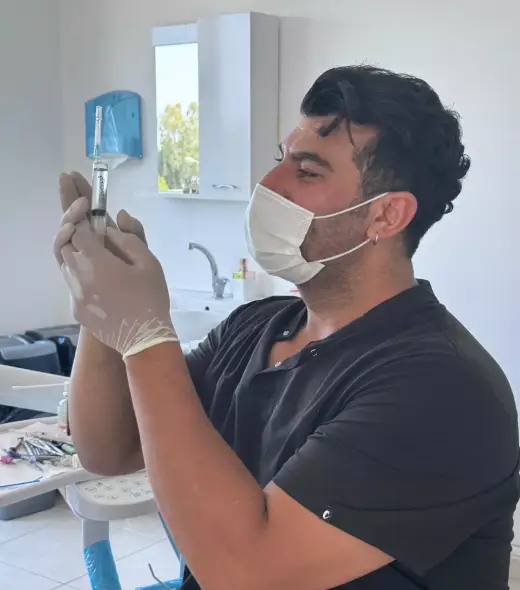
Dental Implants
A dental implant is a small titanium or zirconia post placed into the jawbone to replace a missing tooth root. Once it has fused with the bone — a process called osseointegration — a crown is attached on top to restore the tooth’s shape and function. Treatment typically runs across several visits over a few months, with healing time built in between the surgical and restorative stages.
What a Dental Implant Is and Who It Suits
A dental implant replaces a missing tooth from the root up, rather than only covering the visible part of the tooth the way a bridge or denture does. It consists of three parts: the implant itself (the post placed in the bone), an abutment (a connector piece), and a crown (the visible tooth). Because the implant sits in the bone the same way a natural root does, it can help preserve jawbone volume in the area — bone that tends to shrink over time once a tooth is lost and nothing replaces the root.
Implants suit adults who have lost one or more teeth to decay, trauma, or gum disease, and who have (or can be given, through grafting) enough healthy bone to support a post. They are not typically placed until jaw growth is complete, so they are not offered to younger teenagers. Beyond that, candidacy depends on bone volume, gum health, general health, and lifestyle factors covered in the contraindications section below.
How Implant Treatment Works, Step by Step
- Consultation and imaging. The dentist examines the mouth and takes X-rays or a 3D scan (CBCT) to check bone volume, bone density, and the position of nerves and sinuses before planning implant placement.
- Preparation, if needed. If a tooth needs to be removed first, or if there isn’t enough bone to support an implant, extraction and/or bone grafting happens before or alongside implant placement.
- Implant placement. The implant post is inserted into the jawbone under local anaesthesia. A protective cover or a temporary healing abutment is placed over it.
- Healing (osseointegration). The bone gradually fuses to the implant surface. This is the stage that takes the most time and cannot be rushed without risking implant failure.
- Abutment and impression. Once healing is confirmed, the abutment is attached and an impression or digital scan is taken to design the crown.
- Final crown fitted. The finished crown is checked for fit and bite, then permanently attached to the abutment.
How Many Visits and How Long It Takes
Implant treatment is not a single-visit procedure. At minimum, expect a consultation visit, a surgical visit, a follow-up to check healing, an abutment/impression visit, and a final fitting — five visits is a realistic baseline, more if extraction or bone grafting is needed first.
Healing time between the surgical and restorative stages is commonly cited as roughly three to six months, though this varies by patient, by jaw (the lower jaw generally heals faster than the upper jaw), and by whether grafting was needed. These are general ranges, not a promise of a specific timeline for any individual case — your dentist will give you a schedule based on your own healing progress.
Implant Types and Materials
Two implant materials are commonly used today:
- Titanium implants — the most widely used option, chosen for its long track record and how reliably bone fuses to it.
- Zirconia implants — a metal-free ceramic alternative, sometimes chosen by patients who prefer to avoid metal in the mouth or who have a titanium sensitivity.
Implants also differ by design — some systems use a single connected piece, others separate the implant post and abutment so the crown can be adjusted independently later. Crowns can be either screw-retained (removable by the dentist for maintenance) or cement-retained (bonded permanently in place). Which combination suits a given case depends on the tooth’s position, the bite, and bone quality.
Not sure whether this applies to your teeth?
The only way to know is an examination. Ask a question first if you would rather understand the options before booking anything.
Who Should Not Get an Implant (Contraindications)
Honest information here matters more than a sales pitch. Implants are not right for everyone, and a responsible dentist will screen for these before recommending treatment:
- Uncontrolled diabetes — impairs healing and raises infection risk.
- Active gum disease (periodontitis) — needs to be treated and stabilised first, since infected gum tissue undermines implant success.
- Heavy smoking — significantly reduces the rate of successful bone integration.
- Insufficient jawbone volume without grafting to build it up first.
- Certain medications, including some bisphosphonates used for osteoporosis, which can affect bone healing.
- Uncontrolled bruxism (teeth grinding) — may require a protective night guard to protect the implant and crown from excess force.
- Recent radiotherapy to the jaw, which affects bone healing capacity.
This list is general dental guidance, not a diagnosis — a full medical history review during consultation determines individual suitability.
Caring for an Implant After Placement
In the first 24–48 hours after surgical placement, a soft diet, avoiding smoking, and gentle oral hygiene around the surgical site help healing. Mild swelling and discomfort in the first few days is normal and is usually managed with the painkillers or antibiotics prescribed, if any. Disturbing the surgical site — poking it with a tongue or toothbrush, or eating on that side too soon — can interfere with integration.
Once the crown is fitted, an implant is cared for like a natural tooth: regular brushing and flossing (or interdental brushes, which reach around the crown more effectively than floss for some patients), plus routine dental check-ups so the dentist can monitor the implant and surrounding gum over time.
Frequently asked questions
Is it safe to get dental implants in Turkey?
Safety depends on the individual practitioner and clinic, not the country as a whole. Look for a dentist who is transparent about their training, uses proper 3D imaging to plan placement, explains risks honestly rather than promising guaranteed results, and gives you time to ask questions before treatment. The same due diligence applies wherever you have the procedure done.
How long does it take for a dental implant to heal?
Osseointegration — the bone fusing to the implant — is generally cited as taking around three to six months, though this varies by patient, jaw, and bone quality at the time of placement. Your dentist will confirm healing progress with an exam or X-ray before moving to the restorative stage, rather than working from a fixed calendar date.
What's the difference between titanium and zirconia implants?
Titanium implants have decades of clinical use and a strong integration track record. Zirconia implants are a metal-free ceramic option, often chosen for cosmetic or sensitivity reasons. Both aim for the same result — a stable post the bone fuses around — and suitability depends on the individual case.
Can I get an implant if I don't have enough jawbone?
Not immediately, but bone grafting can often build up the site first. This adds time and an extra healing phase to the overall treatment, but it can make implant placement possible where it otherwise wouldn’t be. A 3D scan during consultation is how bone volume is assessed.
How many visits does implant treatment take?
Typically five or more, spread across several months: consultation, surgical placement, a healing check, an abutment/impression visit, and the final crown fitting. Cases needing extraction or bone grafting first involve additional visits.
Is getting a dental implant painful?
The placement itself is done under local anaesthesia, so patients generally don’t feel pain during the procedure. Mild soreness and swelling for a few days afterward is common and typically managed with over-the-counter or prescribed pain relief, similar to recovery after a tooth extraction.
What happens if an implant fails to integrate?
Implant failure is uncommon but possible, most often linked to infection, insufficient bone support, or the contraindications listed above. If integration doesn’t succeed, the implant is removed, the site is allowed to heal, and placement can often be attempted again once the underlying issue is addressed.
Questions about this treatment?
Every case is different. The most useful first step is an examination, where the options for your teeth can be explained in person.