Skip to content Skip to footer
Oral Surgery

All-on-6 Dental Implants

All-on-6 replaces a full row of missing or failing teeth with a fixed bridge supported by six implants per arch, rather than four. The extra two implants spread biting force across more support points, which is why All-on-6 is often considered when a patient has enough bone to place additional implants or when the dentist judges the extra support will serve the bite better over the long term.

What All-on-6 Is and Who It Suits

Like All-on-4, All-on-6 is a full-arch solution: instead of replacing each missing tooth individually, a set of implants anchors one continuous fixed bridge across the jaw. The difference is in the number and distribution of implants — six per arch instead of four — which changes how the biting load is shared and can allow for a slightly longer bridge span or additional back-tooth support in patients whose bone anatomy and bite pattern suit it.

All-on-6 tends to suit patients who are missing most or all of their teeth in an arch, who have adequate bone volume across more of the jaw (not only at the front), and for whom the dentist judges that extra implant support is worth the additional surgical sites — for example, patients with strong bite forces or specific anatomical considerations identified on 3D imaging.

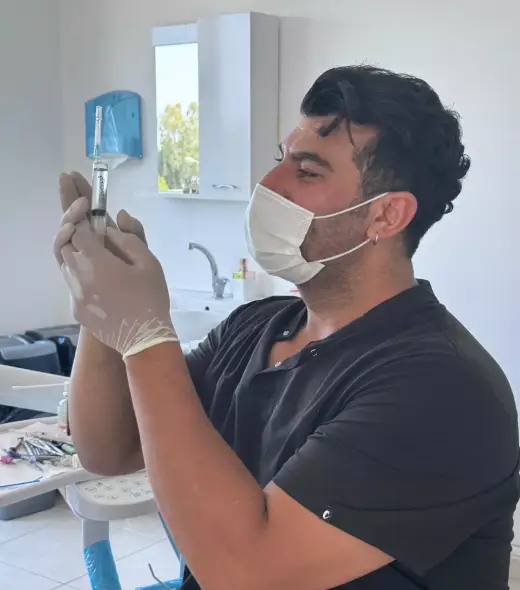
Dt. Cebrail Sağlam, dentist in Alanya
Dt. Cebrail Sağlam preparing an anaesthetic during treatment

How All-on-6 Works, Step by Step

  1. Consultation and 3D imaging. A CBCT scan assesses bone volume across the whole arch, since All-on-6 relies on adequate bone at more implant sites than All-on-4.
  2. Extraction, if needed. Any remaining teeth in the arch that can’t be saved are removed, sometimes on the same day as implant placement.
  3. Implant placement. Six implants are placed per arch under local anaesthesia, positioned to distribute bite force evenly across the jaw.
  4. Temporary bridge, where possible. As with All-on-4, a temporary fixed bridge may be attached soon after surgery if enough implant stability is achieved — this is decided case by case, not guaranteed upfront.
  5. Healing period. The implants integrate with the bone over several months before the final bridge is fabricated.
  6. Final bridge fitted. A custom, permanent bridge replaces the temporary one once healing is confirmed by exam or imaging.

How Many Visits and How Long It Takes

Expect a similar visit structure to All-on-4: a planning consultation, a surgical day, a temporary-bridge stage where applicable, healing check-ups, and a final delivery visit — generally five or more appointments over several months. Because All-on-6 involves more implant sites, some patients find the surgical and initial healing stage slightly more involved than All-on-4, though final bridge timing still tends to fall in the same broad three-to-six-month integration window cited for implants generally. These are approximate ranges — your dentist will set a schedule based on your own healing.

All-on-6 vs. All-on-4, and Other Variants

The choice between six and four implants is a clinical decision based on your 3D scan, not a matter of one option being categorically superior. All-on-4 was specifically designed to work with less available bone by angling the posterior implants into denser bone at the front of the jaw; All-on-6 is generally considered when more bone is present throughout the arch, or when the dentist judges that spreading load across six support points better suits a patient’s bite. Neither is a universal upgrade over the other — see /treatments/all-on-4/ for the comparison in detail.

As with All-on-4, the final bridge material can vary — commonly an acrylic-and-metal hybrid or a zirconia framework — and loading protocol (temporary bridge soon after surgery versus a longer healing period first) depends on the stability achieved during placement, not on patient preference alone.

Before you decide

Not sure whether this applies to your teeth?

The only way to know is an examination. Ask a question first if you would rather understand the options before booking anything.

Contraindications and Limitations

The same general considerations that apply to any full-arch implant treatment apply here, and with six implant sites instead of four, adequate bone across a larger area of the jaw matters more:

  • Insufficient bone volume at enough of the six planned implant sites, even after considering grafting options.
  • Uncontrolled diabetes or other conditions that impair healing.
  • Heavy smoking, which reduces the success rate of implant integration.
  • Active oral infection, which needs to be treated before implant placement.
  • Severe, unmanaged bruxism, which places significant stress on a fixed full-arch bridge over time.

This is general guidance, not a diagnosis — actual suitability is determined by a full medical and dental history review plus 3D imaging during consultation.

Caring for an All-on-6 Bridge After Treatment

Care follows the same pattern as All-on-4: a soft-food period is typical while the implants begin to integrate, smoking is discouraged during healing, and cleaning under the fixed bridge requires specific tools like interdental brushes or a water flosser rather than standard floss. Your dentist will show you the technique that suits your bridge design.

Because All-on-6 has more implant sites to monitor, regular follow-up check-ups matter just as much long term, so the dentist can assess each implant, the surrounding gum tissue, and the bridge itself over time.

FAQ

Frequently asked questions

Neither is universally better; the right choice depends on your bone volume, bite forces, and overall jaw anatomy as seen on a 3D scan. All-on-4 was designed to work with less bone using angled implants, while All-on-6 is often chosen when more bone is available or extra support is judged worthwhile. This is a clinical decision made during consultation, not a matter of preference.

More than All-on-4 typically requires, since six implant sites need to be adequately supported rather than four. A CBCT scan during consultation shows exactly how much bone is available across your jaw and whether grafting would be needed at any of the planned sites.

Spreading bite force across six implants rather than four can, in principle, distribute load more evenly, but durability in practice depends heavily on oral hygiene, bite habits, bone quality, and regular maintenance — not on implant count alone. Your dentist can discuss what’s realistic for your specific case.

Osseointegration timelines are broadly similar to other implant treatments, commonly cited in the range of three to six months, though the additional implant sites in All-on-6 mean your dentist will confirm healing progress individually at each site before the final bridge is fitted.

Converting from a four-implant to a six-implant arrangement is a case-specific surgical question that depends on the position of the existing implants and available bone. This isn’t something a general answer can responsibly cover — it needs an in-person assessment.

Next step

Questions about this treatment?

Every case is different. The most useful first step is an examination, where the options for your teeth can be explained in person.