Skip to content Skip to footer
Endodontics

Root Canal Treatment in Alanya

Root canal treatment, also called endodontic treatment, removes infected or inflamed tissue from inside a tooth, disinfects the empty canal, and seals it to stop the pain and prevent the infection from spreading further. It is used when deep decay, a crack, or repeated dental work has reached the nerve at the centre of the tooth. Most cases are completed in one to three appointments, depending on the tooth and how much infection is present.

What root canal treatment is and who needs it

A tooth has a hard outer layer (enamel and dentin) and a soft centre called the pulp, which contains nerves and blood vessels. When bacteria reach the pulp — through deep decay, a crack, a failed filling, or trauma — the tissue becomes inflamed or infected. This causes pain, sensitivity to hot or cold that lingers, or swelling, and it does not resolve on its own.

Root canal treatment is the way to keep the tooth rather than remove it. It is considered when the pulp is damaged beyond the point where it can heal, but the outer structure of the tooth is still sound enough to restore afterward.

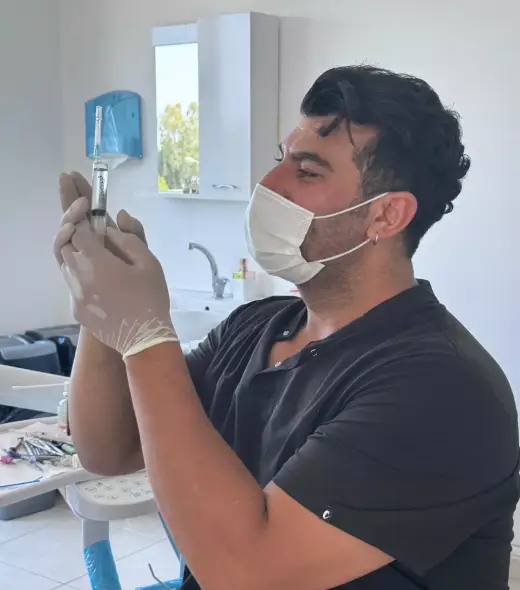
Dt. Cebrail Sağlam, dentist in Alanya
Dt. Cebrail Sağlam preparing an anaesthetic during treatment

Signs that point to a tooth needing evaluation now

  • Pain that lingers well after hot or cold food or drink, rather than fading in seconds
  • Pain when biting or chewing on one specific tooth
  • Swelling of the gum near a tooth, or a small bump that looks like a pimple on the gum
  • A tooth that has darkened compared with the ones next to it
  • Pain that wakes you up at night

None of these signs mean you must self-treat at home. They point to inflammation or infection inside the tooth that needs an exam and, usually, an X-ray to confirm before any treatment decision is made. If there is visible facial swelling, fever, or difficulty opening your mouth or swallowing, that points to a spreading infection and needs prompt evaluation rather than being left over a day or two.

How root canal treatment is performed

  1. Examination and X-ray. The tooth and surrounding bone are checked, usually with an X-ray, to confirm the diagnosis and see the shape of the root canals.
  2. Local anesthetic. The tooth and surrounding gum are numbed before any instrument touches the tooth.
  3. Isolation. A thin rubber sheet is typically placed around the tooth to keep the area dry and free of saliva during treatment.
  4. Access and cleaning. A small opening is made into the tooth, and the infected or inflamed pulp tissue is removed from each canal using fine instruments.
  5. Shaping and disinfection. The canals are shaped and irrigated with a disinfecting solution to remove bacteria from the canal walls, including areas instruments can’t fully reach mechanically.
  6. Filling and sealing. Once the canals are clean and dry, they are filled with a biocompatible material and sealed to prevent bacteria from re-entering.
  7. Restoration. The access opening is closed with a filling. Many back teeth also need a crown afterward to protect them from fracturing under normal chewing force.

Local anesthetic and what to expect

Local anesthetic is used to numb the tooth and gum before treatment begins, and the aim is a comfortable procedure. Most patients feel pressure, vibration, or the sound of instruments rather than sharp pain once the anesthetic has taken effect. Mild tenderness in the treated tooth and surrounding gum for a day or two afterward is common while the tissue settles, and it typically eases on its own within a few days.

How many visits and how long it takes

The number of visits depends mainly on how many canals the tooth has and whether there is active infection. Front teeth usually have a single canal and can often be completed in one longer visit. Molars can have three or four canals and more complex anatomy, which sometimes needs an additional appointment. Where there is significant infection, a dentist may place a temporary dressing first and complete the filling and sealing at a second visit once symptoms have settled. These are general ranges — the exact plan depends on what is found once treatment starts.

First-time treatment vs retreatment

A tooth that has never had root canal treatment before (“primary” treatment) generally has a high rate of long-term success, because the canal anatomy is intact and hasn’t been altered by earlier work.

Retreatment is different. It is needed when a tooth that was treated before develops new pain, swelling, or infection — often because bacteria found their way back into the canal, a canal was missed the first time, or the seal broke down over time. Retreatment involves removing the old filling material, re-cleaning the canals, and resealing them.

Retreatment is honestly a less predictable procedure than a first-time root canal. The canal anatomy has already been altered by the first treatment, and some areas can be harder to fully clean a second time. In some cases, retreatment isn’t the right option and extraction, sometimes followed by a replacement such as a bridge or implant, is discussed instead.

Before you decide

Not sure whether this applies to your teeth?

The only way to know is an examination. Ask a question first if you would rather understand the options before booking anything.

Filling vs crown afterward

A front tooth that carries relatively light chewing force can often be restored with a filling alone once root canal treatment is complete. Back teeth — premolars and especially molars — carry much heavier chewing forces and are more prone to cracking after the procedure, since removing the pulp and shaping the canals leaves less structure behind. For this reason, a crown is commonly recommended for molars and premolars to protect the tooth long-term, while front teeth are assessed case by case.

When root canal treatment isn't the right option

Root canal treatment isn’t always possible or advisable. It may not be recommended when:

  • The tooth has lost too much structure to be reliably restored afterward
  • A crack extends down into the root, below the level that can be repaired
  • There isn’t enough supporting bone left around the root
  • The canal system can’t be adequately cleaned or sealed due to its shape

In these situations, extraction is usually the more predictable option, sometimes followed by a discussion of replacement options such as a bridge, denture, or implant.

Aftercare

  • Avoid chewing on the treated tooth with hard or sticky food until any permanent filling or crown is in place.
  • Mild soreness for a day or two is common and typically improves on its own.
  • Keep up normal brushing and flossing around the tooth.
  • Contact a dentist if pain increases rather than easing, or if swelling appears after treatment — this isn’t typical and should be checked.
  • If a crown was recommended, completing it in the weeks that follow protects the tooth from fracturing under chewing force.
FAQ

Frequently asked questions

Lingering sensitivity to hot or cold, pain when biting on a specific tooth, gum swelling near a tooth, or a tooth that has darkened are the most common signs. An exam and X-ray confirm the diagnosis — these signs alone don’t always mean root canal treatment is needed.

The tooth and gum are numbed with local anesthetic before treatment starts, and most patients feel pressure or vibration rather than sharp pain during the procedure. Some tenderness for a day or two afterward is common and usually eases on its own.

Usually one to three visits, depending on how many canals the tooth has and whether there’s active infection. Front teeth with a single canal are often completed sooner than molars with several canals.

For a tooth without significant infection, treatment can often be completed in a single longer visit. Where infection is present, a dentist may complete the cleaning first and finish sealing the tooth at a second visit once symptoms have settled.

The infection can spread into the surrounding bone and gum, cause a dental abscess, and become more painful and harder to treat. In some cases it leads to loss of the tooth. It doesn’t resolve without treatment.

Root canal treatment removes the infected tissue inside the tooth so the natural tooth can be kept. Extraction removes the tooth entirely. Root canal treatment is generally preferred when the tooth can be reliably restored afterward; extraction is considered when it can’t.

A properly treated and restored tooth, particularly one protected with a crown when needed, can function for many years. Long-term success also depends on ongoing oral hygiene and regular dental checkups.

No — retreatment has lower predictability than a first-time root canal, since the canal anatomy has already been altered and some areas can be harder to clean fully a second time. It’s still often worth attempting before considering extraction.

Next step

Questions about this treatment?

Every case is different. The most useful first step is an examination, where the options for your teeth can be explained in person.