Skip to content Skip to footer
Periodontics

Gum Disease Treatment in Alanya

Gum treatment addresses inflammation and infection in the tissue and bone that support the teeth, ranging from gingivitis (early, reversible gum inflammation) to periodontitis (more advanced disease that has started to affect the bone). Treatment usually begins with scaling and root planing — a thorough professional cleaning that removes plaque and tartar from above and below the gumline. Bleeding, swollen, or receding gums are the main warning signs, and they are worth having examined rather than waited out, since gum disease doesn’t reverse on its own once tartar has hardened below the gumline.

What gum disease is and why it needs treatment

Plaque is a soft film of bacteria that builds up on teeth every day. If it isn’t removed, it hardens into tartar, which can’t be brushed away and irritates the gums. That irritation is gingivitis — redness, swelling, and bleeding when you brush, without any loss of the bone underneath.

Left untreated, gingivitis can progress to periodontitis, where the infection spreads below the gumline and starts to affect the ligament and bone that hold the tooth in place. This creates deeper “pockets” between the tooth and gum where bacteria collect. Periodontitis doesn’t heal itself with brushing alone — the deposits below the gumline need to be removed professionally, and the earlier it’s treated, the easier it is to manage.

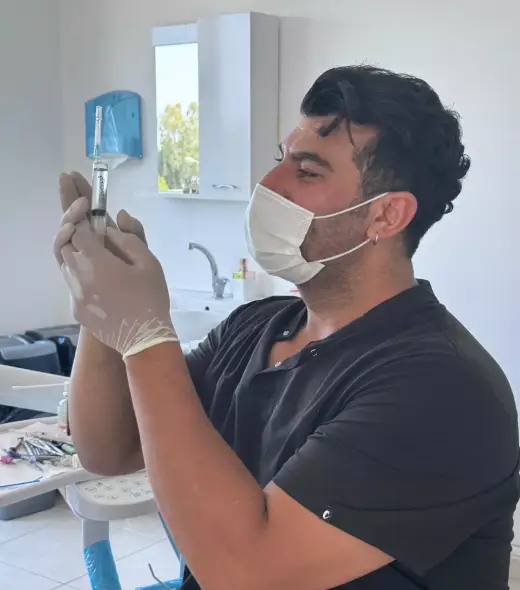
Dt. Cebrail Sağlam, dentist in Alanya
Dt. Cebrail Sağlam preparing an anaesthetic during treatment

Signs it's time for an exam, not just a better toothbrush

  • Gums that bleed when you brush or floss
  • Red, swollen, or tender gums
  • Gums that appear to be pulling away from the teeth, making teeth look longer
  • Persistent bad breath or a bad taste that doesn’t go away with brushing
  • Teeth that feel slightly loose
  • Pus visible between a tooth and the gum

These signs point to inflammation that a toothbrush alone can’t reverse once tartar has built up below the gumline. Home care matters and stays important throughout treatment, but on its own it works alongside a professional cleaning, not instead of one.

How gum treatment is performed, step by step

  1. Examination and periodontal charting. The depth of the space between each tooth and gum (the “pocket”) is measured around the mouth to assess how far the disease has progressed.
  2. Scaling. Plaque and tartar are removed from the tooth surface, both above and below the gumline, using hand instruments or an ultrasonic device.
  3. Root planing. The root surface is smoothed so that bacteria have less to attach to and the gum tissue has a better chance to reattach to the tooth.
  4. Local anesthetic where needed. For deeper pockets, local anesthetic is used so root planing can be carried out thoroughly and comfortably.
  5. Re-evaluation. A follow-up appointment some weeks later checks how the gums have responded and measures pocket depth again.
  6. Further care if needed. Areas that haven’t responded to non-surgical treatment may need additional sessions or referral for further periodontal care.

How many sessions it takes

Gingivitis often improves within a few weeks once tartar is removed professionally and home hygiene improves — sometimes after a single thorough cleaning. Periodontitis usually takes longer: the mouth is often treated in sections across two to four visits, followed by a re-evaluation appointment several weeks later to check how the tissue has healed. These are general ranges; the actual plan depends on how many areas are affected and how deep the pockets are.

What affects how gum disease is treated

Treatment depends on how far the disease has progressed and whether it’s localized to a few teeth or affects the whole mouth. Most cases start with non-surgical scaling and root planing. Deeper pockets or areas that don’t respond may need referral for further or surgical periodontal care.

Laser-assisted periodontal treatment is used by some practices as an alternative or addition to traditional scaling and root planing in certain cases. Current evidence doesn’t consistently show it outperforming traditional treatment for long-term results — it’s one option among several rather than an upgrade that’s right for everyone, and whether it’s suitable depends on the specific case.

Before you decide

Not sure whether this applies to your teeth?

The only way to know is an examination. Ask a question first if you would rather understand the options before booking anything.

Contraindications and limits — being honest about it

Gum treatment reduces inflammation and can stop periodontitis from progressing, but it doesn’t reverse bone that has already been lost, and it isn’t a one-time fix. Gum disease can return if plaque control at home and regular maintenance cleanings aren’t kept up afterward. Deep pockets or advanced bone loss that don’t respond to non-surgical treatment may need referral for further evaluation or surgical care beyond what a routine cleaning can achieve.

Aftercare

  • Gums can feel tender and may bleed a little for a day or two after scaling and root planing — this settles as healing progresses.
  • Some sensitivity to hot, cold, or sweet food is common short-term, particularly if root surfaces were exposed.
  • Gentle brushing and flossing should continue and often improve during healing rather than being paused.
  • Avoiding smoking supports healing, since smoking is a well-established factor that slows gum healing and increases the risk of disease returning.
  • Maintenance cleanings on a schedule set after re-evaluation are what keep gum disease from coming back — this is ongoing care, not a single visit.
FAQ

Frequently asked questions

Bleeding when brushing is usually a sign of gingivitis — inflammation caused by plaque and tartar along the gumline. It’s one of the earliest and most reliable signs that gums need attention, and it typically improves once the irritant is removed professionally and home hygiene improves.

Gingivitis is inflammation limited to the gum tissue, without loss of the bone underneath, and it’s reversible with treatment. Periodontitis is more advanced: the infection has spread to affect the bone and ligament supporting the tooth, creating pockets that need professional cleaning below the gumline to manage.

Gingivitis is reversible with professional cleaning and consistent home care. Periodontitis can be controlled and stopped from progressing, but bone that has already been lost generally doesn’t grow back on its own — which is why catching gum disease early matters.

Scaling removes plaque and tartar from the tooth surface above and below the gumline. Root planing smooths the root surface underneath so the gum has a better chance of reattaching and bacteria have less surface to cling to. It’s usually done with local anesthetic for comfort when pockets are deep.

It depends on how far the disease has progressed. Gingivitis often improves after one thorough cleaning. Periodontitis is usually treated over two to four visits, plus a follow-up re-evaluation appointment a few weeks later.

Yes, if plaque control at home and regular maintenance cleanings aren’t kept up. Gum disease is managed on an ongoing basis rather than cured once and forgotten.

Generally no — gum recession doesn’t reverse on its own. Treatment focuses on stopping the disease that’s causing it from progressing further and protecting the exposed root surface, rather than regrowing the original gum tissue.

Next step

Questions about this treatment?

Every case is different. The most useful first step is an examination, where the options for your teeth can be explained in person.