Skip to content Skip to footer
Prosthodontics

Dentures

Dentures are removable appliances that replace some or all missing teeth, restoring the ability to chew and speak and supporting the shape of the face and lips. They range from a complete denture for a fully toothless jaw to a partial denture that fits around remaining natural teeth, and can rest on the gum conventionally or be stabilized with dental implants.

What Dentures Are and Who Needs Them

  • Complete (full) dentures replace every tooth in an upper or lower arch.
  • Partial dentures replace some missing teeth while the remaining natural teeth stay in place, held with metal clasps or, for a less visible option, precision attachments.

Dentures tend to suit patients who are missing most or all of the teeth in an arch due to decay, gum disease, or past extractions; who prefer a removable option over a fixed implant-supported alternative; or who are not yet eligible for implants and want a functional interim or long-term solution.

Dt. Cebrail Sağlam, dentist in Alanya
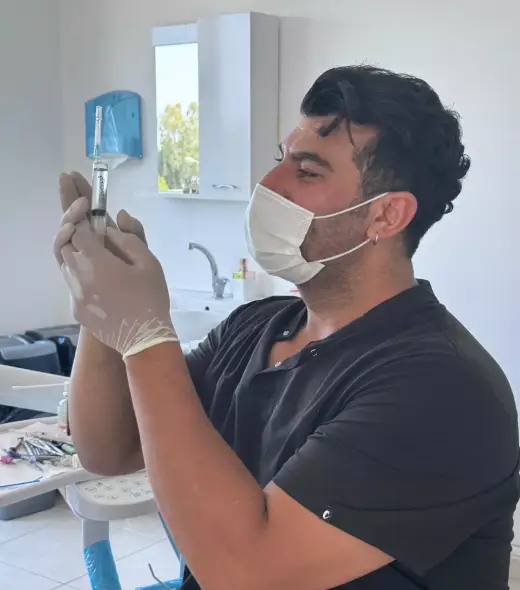
Dt. Cebrail Sağlam preparing an anaesthetic during treatment

How Dentures Are Made and Fitted

  1. Examination and impressions of the gums and jaw.
  2. Bite registration, recording how the upper and lower jaws come together.
  3. Wax try-in, checking fit, shade, and appearance before the final piece is processed.
  4. Final delivery, fitting the finished denture and adjusting it as needed.
  5. Follow-up visits to ease sore spots as the mouth adapts to the new appliance.

Visits and Timeline

Conventional dentures commonly take several visits over a few weeks. If teeth need to be extracted first, healing time — commonly around two months — is generally needed before a well-fitting final denture can be made. An immediate denture, placed on the same day as extraction, is an option some patients discuss with their dentist to avoid a gap during healing. Because the gum and jawbone keep changing shape as extraction sites heal, an immediate denture typically needs one or more relines in the following months to keep a good fit.

Materials Used in Dentures

Denture teeth are typically made from acrylic resin or, less commonly, porcelain, set into a base usually shaped from pink acrylic to resemble the gums. A partial denture may also include a metal framework, commonly a chrome-cobalt alloy, for extra rigidity and a thinner, more comfortable fit than an all-acrylic partial. The combination of materials used depends on the number of teeth being replaced, the bite forces involved, and whether a metal framework or a fully acrylic design suits the case better.

Adjusting to a New Denture

It’s common to notice increased saliva, a change in speech, and mild soreness in the first days or weeks with a new denture, as the mouth and tongue adapt to the appliance. Reading aloud and starting with softer foods cut into smaller pieces can help during this period. A persistent sore spot or a denture that feels loose should be brought back to the dentist for adjustment rather than managed at home, since even a small pressure point can cause ongoing irritation if left unaddressed.

Before you decide

Not sure whether this applies to your teeth?

The only way to know is an examination. Ask a question first if you would rather understand the options before booking anything.

Types of Dentures

  • Complete (full) dentures — replace all teeth in an arch, resting on the gum ridge.
  • Partial dentures — replace some missing teeth while natural teeth remain, held by clasps or, for a less visible appearance, precision attachments (see prosthodontics for detail).
  • Implant-supported dentures (overdentures) — clip onto a small number of implants for significantly more stability than a conventional denture, while remaining removable for cleaning. See the dental implants page.
  • Implant-supported fixed prostheses — a non-removable alternative permanently anchored to implants, covered on the prosthodontics page.

Who Should Be Cautious With Conventional Dentures

  • A strong gag reflex can make adjusting to an upper full denture take longer.
  • Significant bone loss in the jaw can make a stable, comfortable fit harder to achieve with a conventional, non-implant denture.
  • Patients wanting a fixed, non-removable result should discuss implant-supported options instead.
  • Patients who have never worn a denture before may need more adjustment visits early on than someone replacing an existing denture with a new one.

Aftercare

Remove and clean dentures daily with a denture-specific brush and cleanser, not regular toothpaste, which can be abrasive to the material. Soak overnight in the solution recommended by the dentist unless advised otherwise, and give the gums a rest from the appliance overnight where advised. Return for periodic check-ups, since the jawbone and gums change shape over time, which can loosen the fit and may call for a reline or eventual replacement.

FAQ

Frequently asked questions

Exact costs are not published online, since they depend on whether the denture is complete or partial, conventional or implant-supported, and the materials used. A written treatment plan is provided at consultation.

Commonly a few weeks. Speech and chewing generally improve steadily as the muscles, tongue, and cheeks adapt — this varies from person to person.

Yes — an implant-supported overdenture clips onto a small number of implants for much greater stability than a conventional denture while remaining removable. See the dental implants page.

Yes, generally. As the jawbone and gums reshape over the years, a denture’s fit loosens, which can call for a reline or, eventually, a new denture. There is no fixed schedule — it depends on the individual.

A precision-attachment partial is less visible than a clasp-retained one, since it has no visible metal hooks. Both restore chewing function; the choice is largely about appearance and cost.

Generally yes, once the adaptation period is over, though very hard or sticky foods are usually approached carefully at first.

Many dentists recommend removing dentures at night to give the gums a rest and reduce the risk of irritation, though this is discussed individually — some patients are advised differently depending on their situation.

A cracked or broken denture shouldn’t be worn until it’s been assessed, since a poor fit or a sharp edge can irritate the gums. Many breaks can be repaired, though a denture that has broken repeatedly may need to be remade.

Often yes. A reline adds new material to the fitting surface of an existing denture to match a gum shape that has changed over time, which can extend its use without a full remake. Whether a reline or a new denture is the better option depends on the overall condition of the existing piece.

Yes — that’s one of their functions alongside restoring chewing ability. Leaving a gap unfilled can allow neighboring and opposing teeth to drift or over-erupt over time, which can complicate treatment later, so replacing a missing tooth reasonably promptly is generally advised.

Next step

Questions about this treatment?

Every case is different. The most useful first step is an examination, where the options for your teeth can be explained in person.